
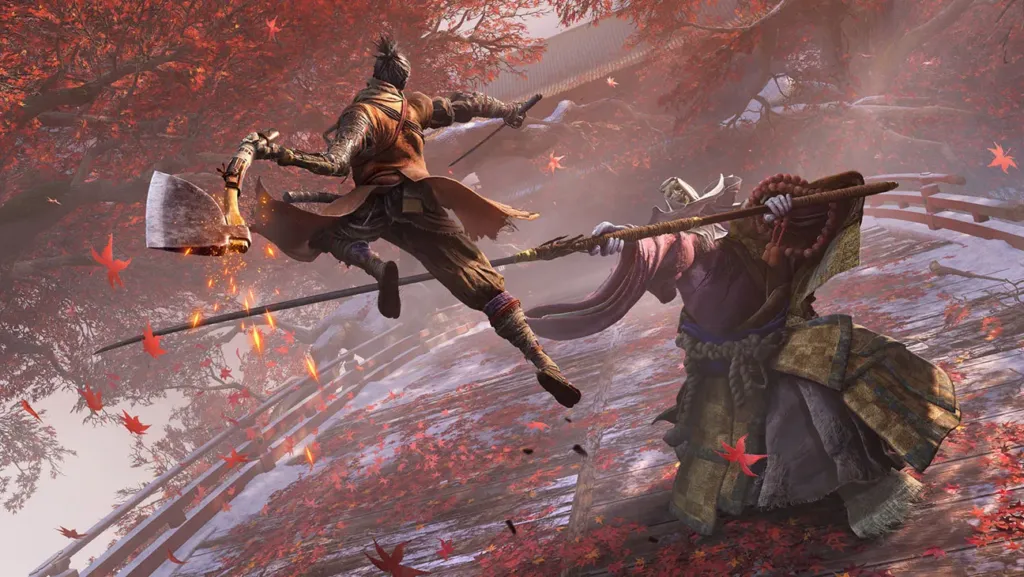
The first time Isshin the Sword Saint killed me, I put the controller down and did not touch the game for a week. Then I came back, drilled the deflect timing until it lived in my thumbs, and beat him on the next sitting. That loop, where a brick wall slowly turns into muscle memory and then into a win, is the actual thing you are chasing when you go looking for games like Sekiro.
Sekiro: Shadows Die Twice is not really a stat-based RPG the way Dark Souls is. It is a rhythm game with swords. You hold your ground, you deflect instead of dodge, and you break an enemy’s posture instead of chipping their health. Nothing else plays exactly like it, so this list splits the difference. Some of these games copy the deflect-heavy combat almost note for note. Others just give you that same tense, one-more-try feeling. I have added the newer heavy hitters from 2024 and 2025 too, because the genre has moved a lot since this list first went up.
Wo Long: Fallen Dynasty
If you want the closest thing to Sekiro’s combat without playing Sekiro again, start here. Wo Long is built around the Deflect, a parry you time against incoming attacks to drain the enemy’s Spirit gauge. Land enough of them and you open a Fatal Strike, which is basically Sekiro’s deathblow with a Three Kingdoms coat of paint. Team Ninja made this, so the movement is fast and the bosses do not wait around for you.
The Morale system is the one thing that trips people up early. Die and your Morale rank drops, which makes the same enemies hit harder, so a bad run can snowball. Once it clicks though, it pushes you to play aggressive instead of turtling. This is the pick for anyone who missed the deflect timing the second Sekiro ended.
Image: add a Wo Long: Fallen Dynasty combat screenshot here.
Nioh 2
Nioh 2 is what happens when you take the difficulty of Sekiro and bolt on a loot system deep enough to lose a weekend in. It is set in a supernatural version of Sengoku-era Japan, the same rough period as Sekiro, and you fight yokai as a half-demon of your own making. The combat runs on three stances per weapon, and the Ki Pulse lets you recover stamina by tapping a button at the right moment during a combo. It rewards precision the same way Sekiro does, just with more menus.
Fair warning, this game is harder than Sekiro in places, and the early bosses will humble you before you have any good gear. If you bounce off loot-heavy games you might find it noisy. But if you want hundreds of hours of brutal Japanese action, nothing else on this list gives you more.
Image: add a Nioh 2 boss fight screenshot here.
Rise of the Ronin
Rise of the Ronin came out in 2024, also from Team Ninja, and it is the open-world version of the itch Sekiro scratches. It is set in 1860s Japan during the fall of the shogunate, and the core of every fight is the Counterspark, a last-second parry that shuts down an enemy’s strongest attack. Time it right and even tough duels fold fast. Time it wrong and you eat the whole combo.
It is more forgiving than Sekiro overall, partly because you can swap weapon styles on the fly to counter whoever you are fighting. The open world is a bit generic and the side content thins out, so I would not play it for the map. Play it for the duels, which are the best part by a mile.
Image: add a Rise of the Ronin duel screenshot here.
Ghost of Tsushima
Ghost of Tsushima gives you the samurai fantasy Sekiro sells, minus most of the pain. You play Jin Sakai defending Tsushima island from the 1274 Mongol invasion, and combat leans on stance swapping and parries rather than pure reflex. It is genuinely easier than any Souls game, which is exactly why it belongs near the top for anyone who loved the setting but not the wall of difficulty.
The standoffs are the closest it gets to Sekiro’s tension. You face down a group, wait for the enemy to twitch, and land a one-hit kill if you read it right. The open world is also one of the prettiest ever made, and it runs great on a Steam Deck if you grab the PC version. If you want the vibe without getting bodied for hours, this is the gentle way in.
Ghost of Yotei
Ghost of Yotei is the 2025 follow-up to Tsushima, and it is the most obvious next step if the first one won you over. You play a new lead named Atsu in 1600s Ezo, the region that is now Hokkaido, hunting down a group of outlaws. Sucker Punch kept the stance-based combat and the standoffs but tightened the parry windows, so it sits a notch closer to Sekiro’s precision than Tsushima did.
It does not reinvent the formula, so if Tsushima left you cold this will not change your mind. But the swordplay feels sharper and the northern setting is a nice change from the first game’s fields. For most people who finished Tsushima, this is a straight upgrade.
Image: add a Ghost of Yotei screenshot here.
Lies of P
Lies of P is a dark Pinocchio retelling set in the ruined city of Krat, and its combat is more Sekiro than most Souls games manage. The Perfect Guard rewards you for blocking at the exact frame of an attack, which chips the enemy’s guard and sets up a stagger, much like breaking posture. It looks like Bloodborne but it plays like a deflect game once you commit to guarding instead of running.
The 2025 Overture expansion added a chunk of new bosses and weapons, so there is more here now than at launch. The weapon assembly system, where you bolt any blade onto any handle, is the fun wrinkle that keeps builds interesting. If you want the deflect loop wrapped in a gorgeous, grim world, this is an easy recommendation.
Image: add a Lies of P screenshot here.
Black Myth: Wukong
Black Myth: Wukong was the breakout hit of 2024 and sold over 25 million copies, so you have probably heard the name. It is based on Journey to the West, and you play the Destined One, a staff-wielding monkey working through a string of gorgeous, punishing boss fights. It is not a deflect game, it is more about dodging and staff stances, but the boss design carries that same study-and-conquer rhythm Sekiro fans love.
The transformations are the standout, letting you turn into defeated enemies and use their moves mid-fight. It leans more linear than open, and the mid-game pacing sags a little, but the bosses are some of the best in the genre. This is the pick when you want spectacle to go with your suffering.
Image: add a Black Myth: Wukong boss screenshot here.
Elden Ring
Elden Ring is FromSoftware’s biggest game, and while it is not built around deflection like Sekiro, it is the same studio pushing the same idea of learning a boss until it becomes routine. The difference is freedom. When a boss walls you, you can wander off, get stronger, and come back, which takes some of the sting out of the hard fights. For a lot of players that made it the first Souls game they actually finished.
The 2024 Shadow of the Erdtree expansion is worth calling out on its own. It is huge, it is harder than the base game, and the final bosses ask for the kind of precise timing Sekiro drilled into you. If you want the deepest single package on this list, Elden Ring plus its DLC is hard to beat.

Bloodborne
Bloodborne is the FromSoftware game that taught players to stop hiding behind a shield, so it shares Sekiro’s aggressive streak. Take a hit and you can win the health back by attacking within a few seconds, which pushes you to stay in the fight instead of backing off. The gothic city of Yharnam is still one of the best worlds the studio has ever built.
The catch is that it is stuck on PS4 with no PC port and a locked frame rate, which is a real downer in 2026. If you can look past that, the trick weapons and the speed make it feel closer to Sekiro than Dark Souls does. It is a must-play if you own a PlayStation.

Dark Souls
Dark Souls is the game that started the whole genre, and it is slower and more deliberate than Sekiro on purpose. You manage stamina, pick your moments, and learn the interconnected world of Lordran one bonfire at a time. The parry exists here too, but it is high risk and optional, so most players lean on patience instead of reflexes.
If Sekiro is a sprint, Dark Souls is a long, careful march. Some of the late-game areas have aged rough, and the backtracking can drag. Still, the sense of place and the payoff when you finally crack an area are why people keep going back over a decade later.

Demon’s Souls
Demon’s Souls is where FromSoftware first figured out the formula, and the 2020 Bluepoint remake made it one of the best-looking games on PS5. The structure is a bit different from later Souls games, with five worlds you tackle from a central hub instead of one connected map. Combat is classic and methodical, so it is a Sekiro relative rather than a twin.
The World Tendency system, which shifts difficulty and rewards based on how you play, is either a neat wrinkle or a headache depending on your patience. It is PS5 only, so availability is the main hurdle. If you have the console and want to see where all of this began, it is a gorgeous place to start.

Nioh
The first Nioh is still worth playing even after the sequel, especially if you want more Sengoku-era Japan. You play William, an Irish samurai chasing a thief across a Japan crawling with yokai, and the stance system gives every weapon three completely different rhythms. It is a harder, loot-heavier take on the Sekiro setting.
The mission-based structure means less exploration and more back-to-back combat arenas, which some people love and others miss. The gear grind can get out of hand fast. But the fighting is so good that plenty of players consider it the high point of the sub-genre.

Stellar Blade
Stellar Blade came out in 2024 from Shift Up, and its combat borrows Sekiro’s parry-and-punish core more openly than most people expect. You play Eve, an airborne soldier retaking Earth from monsters called Naytiba, and the fights hinge on perfect parries and perfect dodges that fill a special gauge for big counters. Nail the timing on a tough enemy and it feels a lot like posture-breaking a Sekiro mini-boss.
It is more of a linear action game than an RPG, and the story is fine rather than gripping. The reason to play is the combat and the boss timings, which are tuned tight. If you want a sci-fi spin on the deflect loop, this fills a gap nothing else on the list does.
Image: add a Stellar Blade screenshot here.
Star Wars Jedi: Fallen Order
Fallen Order takes the Souls template and makes it approachable, which is why it is a good bridge for people intimidated by Sekiro. You play Cal Kestis, a surviving Jedi on the run from the Empire, and lightsaber combat runs on blocking and parrying blaster bolts and blades. The parry timing is real, but the game has difficulty options that Sekiro flatly refuses to offer.
It mixes in Metroidvania exploration and some light platforming, so it is not pure combat. The launch version had performance issues, though patches cleaned most of that up. For Star Wars fans or anyone who wants deflect-style fighting on training wheels, it is an easy yes.

Code Vein
Code Vein is the anime-styled Souls game, and it stands out by letting you bring an AI partner into almost every fight. That buddy system makes it noticeably easier than Sekiro, which is either the appeal or the dealbreaker depending on what you want. You play a Revenant in a post-apocalyptic world, feeding on blood to keep your memories.
The Blood Codes work like swappable class builds, so you can respec your whole playstyle between fights. The story is heavy on anime tropes and the environments repeat themselves, which wears thin late. But if you want a softer Souls with a friend at your side, it does that job well.

Devil May Cry 5
Devil May Cry 5 is not a Souls game, but it shares Sekiro’s obsession with reading enemies and reacting fast. This is a stylish action game where the goal is to chain attacks into a high-rank combo without getting hit, so mastery is the whole point. If you liked Sekiro for the flow of a perfect fight more than the punishment, this is your lane.
Three playable characters keep the combat fresh, and the skill ceiling is sky-high once you dig in. It is far more forgiving on normal difficulty than Sekiro, so the pressure comes from wanting to look good rather than from dying. Turn the difficulty up and it will test you plenty.

God of War (2018)
The 2018 God of War reboot borrows a lot of Souls DNA, from the deliberate combat to the way tougher enemies force you to learn their patterns. You play an older Kratos raising his son Atreus, and the Leviathan Axe combat has real weight to every swing. It is more accessible than Sekiro, with difficulty settings and a story that actually slows down to breathe.
The optional Valkyrie fights are where it gets closest to Sekiro’s wall-of-difficulty moments, and they are some of the best boss fights of that console generation. This is the pick when you want challenge alongside a genuinely great story rather than in place of one.

Horizon Forbidden West
I will be honest, Horizon Forbidden West is the loosest fit on this list. It is not a Souls game and it is not really about parrying. What it shares with Sekiro is the thrill of studying a huge, dangerous enemy, spotting the weak point, and taking it down with a plan instead of brute force. Fighting the machine dinosaurs scratches that same puzzle-solving itch.
You play Aloy in a gorgeous post-apocalyptic world, and combat rewards using the right tool on the right machine. It is far easier and more open than Sekiro, so treat it as a palate cleanser rather than a replacement. If you want the tactical hunting feeling without the pain, it delivers.

Monster Hunter Rise
Monster Hunter Rise is about learning a single big enemy so well that you can predict its next move, which is the exact skill Sekiro drills into you. Every hunt starts with you getting flattened and ends, many attempts later, with you dancing around the monster untouched. The Wirebug adds fast aerial movement that keeps the fights snappier than older entries.
The 14 weapon types each play like their own game, so the learning curve is wide rather than steep. It is grindier than Sekiro and the story is thin, but the moment-to-moment combat loop is addictive. If you want that study-the-boss feeling stretched across hundreds of hours, this is it.

Steelrising
Steelrising is a Souslike set in an alternate French Revolution where automatons have crushed the uprising, and you play Aegis, a machine built to fight back. The premise alone sets it apart, and the Paris backdrop is a nice break from the usual dark fantasy. Combat is standard Souls fare built on careful dodging and pattern learning.
It is a mid-budget game and it shows in the animations and the world detail, so temper your expectations. Accessibility options let you soften the difficulty if you want. For a fresh setting and a shorter runtime than the genre giants, it is a solid pick between the heavy hitters.

Blasphemous
Blasphemous drops the 3D combat for a 2D Metroidvania, but it keeps the punishing difficulty and the grim, gorgeous art. You play the Penitent One through a nightmare inspired by Spanish religious imagery, and the pixel art is some of the best in the genre. It is cryptic and unafraid to let you get lost.
The 2023 sequel, Blasphemous 2, tightened the combat and the movement, so start there if you want the smoother version. Both games ask for precise platforming on top of the fights, which can frustrate. If you want Sekiro’s difficulty in a hand-drawn 2D package, this delivers.

Hollow Knight
Hollow Knight is the 2D game that earns its spot on any Souls-adjacent list. You explore the fallen bug kingdom of Hallownest, and the combat is tight and demanding, with boss fights that will kill you until the pattern finally sinks in. The hand-drawn world is huge and rewards curiosity at every turn.
The long-awaited sequel, Silksong, finally landed in 2025, so there is now a fresh reason to jump back into this world. The original can be cryptic about where to go next, which trips up some players. Even so, it is one of the best action games of the last decade, full stop.

So which one should you play next?
If you only want one, play Wo Long: Fallen Dynasty. It copies Sekiro’s deflect loop more faithfully than anything else here, and it is the fastest way to feel that posture-break rush again. Want the samurai setting with less punishment? Ghost of Tsushima or its 2025 sequel are the softer landing. Want the deepest single package? Elden Ring and its Shadow of the Erdtree DLC will eat your next hundred hours.
A lot of these run great on portable hardware too, so if you are gaming on a handheld it is worth checking our guide to the best non-Steam games for the Steam Deck before you load up. And when the bosses have finally worn you down and you need something that will not make you throw a controller, swap over to a couple of the best puzzle co-op games with a friend, or unwind with a browser strategy game from our list of games like Territorial.io. Then come back and finally beat Isshin.


